Wednesday, August 14, 2013
TRIZ for Social Problems


TRIZ Fundamentals 2013 finalized
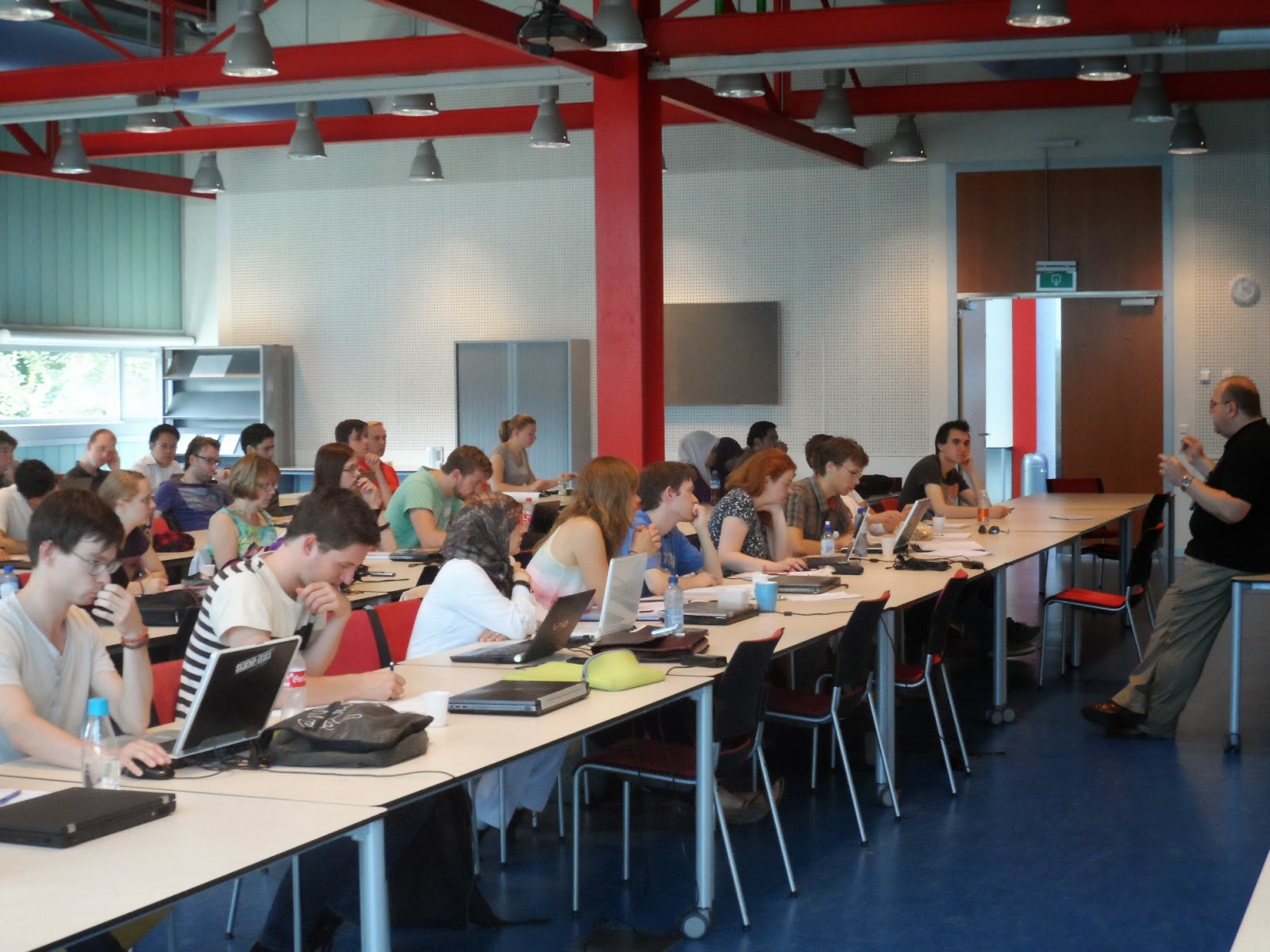
In addition to 41 B.Sc and M.Sc students we had 9 external guests from industry representing 5 countries.
All the participants were split to 15 groups and each group managed to perform 10 practical assignments. The workload was a bit heavy but at the end of the course everyone looked excited. The following subjects and tools were studied this year:
- TRIZ background and systematic approach to innovation
- Ideality and Ideal Final Results
- Evolution of technology through innovation
- Root Conflict Analysis
- 40 Inventive Principles
- Substance-Field Analysis
- 76 Inventive Standards
- Function Analysis
- Trimming
- Value Conflict Mapping
- Introduction to ARIZ
- Models of Technology Evolution
- Trends and Lines of Technology Evolution


Thursday, July 11, 2013
TRIZ Fundamentals 2013 started


Wednesday, November 28, 2012
Online Training: TRIZ and Systematic Innovation tools
http://www.xtriz.com/Training/online_training.htm
Friday, November 09, 2012
Updated: TRIZ and Systematic Innovation courses in 2013
| PUBLIC COURSES, 2012: | ||
| December 12, 2012 Utrecht, Netherlands |
One-day public
training and certification:
Systematic Creative Business Problem Solving | |
| PUBLIC COURSES, 2013: | ||
| January 9-11, 2013 Utrecht, Netherlands |
3-day public training and certification: Basic TRIZ and Systematic Innovation in Technology and Engineering | |
| February 4-8, 2013 Utrecht, Netherlands |
5-day public training
and certification: Advanced TRIZ and Systematic Innovation in Technology and Engineering |
|
| April 3-5, 2013 Utrecht, Netherlands |
3-day public training and
certification: Extended RIZ and Systematic Innovation in Business and Management |
|
| July 2013 (TBD) Enschede, Netherlands |
Two-week (80 hours) Summer Course TRIZ Fundamentals |
|
Saturday, November 03, 2012
Chapter about TRIZ and Technology Roadmapping in The Power of Design
 The Power of Design: Product Innovation in Sustainable Energy Technologies
Edited by Angele Reinders, Jan Carel Diehl, Han Brezet
368 pages
November 2012
Wiley
ISBN: 978-1-1183-0867-7
Thursday, November 01, 2012
TRIZ Future 2012: Brief Report
The event went on October 24-26, 2012. The venue of the conference was at the university campus Caparica, located near the ocean which was really inspiring and provided naturally “fresh” atmosphere.
This time the conference gathered about 90 participants from 27 countries. About 60% of the conference participants represented Europe, 30% Asia Pacific, and 10% other parts of the world, including USA and Australia. The conference featured 4 keynote talks, 2 tutorials, and 60 presentations from 135 authors and co-authors: 28 scientific contributions, 23 practitioner contributions, and 9 short talks. Thanks to the introduction of “short paper” format several years ago, the conference allows short papers to be presented in 10 minutes that extends a number of live presentations at the event. Other papers were presented in a usual, 30 minutes format.
About 50% of the participants represented scientific and research institutions, and about 50% private and industrial organizations.
A full conference program is available. 698-page conference proceedings are available from the organizers. So far it has been the largest volume of the TRIZ Future conference proceedings.
I provided the introductory TRIZ tutorial for the conference participants at the first conference day and later presented a paper on "Functional Value Map" written by my colleagues Ives de Saeger and Kim Rutten.
Social events included the conference dinner, and a dinner with fados, traditional Portuguese style of music and singing. And there was really a lot of informal communication among the conference participants to exchange comments, opinions, ideas, and discussing future collaborations.
The official conference closing was followed by the ETRIA Members meeting where a new President of ETRIA was elected: Prof. Dr. Ir. Joost Duflou, from the K.U. Leuven, Belgium. Many thanks were expressed to Dr. Tom Vaneker, who served as ETRIA President in 2009-2012.
As usual, Ellen Domb, a former editor of the online TRIZ Journal, provided a live coverage of the event with many details, including comments on a number of presentations and keynote talks. See her blog posts about the conference.
The next edition of the conference will be held in Paris, France at the end of October – beginning of November 2013. See the forthcoming news at the ETRIA website.


Friday, September 07, 2012
"TRIZ Future 2012" Preliminary Accepted Presentations
The list of preliminary accepted presentations:
http://triz.h4u.eu/TFC2012PresentationsPreliminary.pdf
The list of tutorials and keynotes:
http://www.trizportugal.com/keynote-speakers/
I will be running a basic tutorial in the morning during the first conference day.
More information on the conference is available at: http://www.trizportugal.com/
Wednesday, August 08, 2012
Tools Used Most Frequently With 10 Types of Innovative Tasks
According to numerous requests, I made an overview of tools which are used most frequently within xTRIZ framework to support 10 types of innovative tasks. The overview can be found at:
http://www.xtriz.com/cs/10_InnovativeTasks_ToolsTable.pdf
Note that tasks 5,6 and 9 are not currently fully supported by neither xTRIZ nor TRIZ tools. In addition, several tools mentioned were developed within xTRIZ and have no direct link to classical TRIZ tools. Some tools (Problem Perception Map, Multi-Criteria Decision Matrix) are taken from areas other than TRIZ or xTRIZ. In addition, extra tools from different areas can be used in different projects and they are not mentioned in the table.
Friday, August 03, 2012
Ten Types of Innovative Tasks
Therefore I use my own classification of ten categories of tasks which can be identified:
- Improve quality of a product, process, or service: e.g. eliminate negative, unwanted and undesired effects, increase robustness.
- Improve performance of a product, process, or service: e.g. raise performance of positive effects, functions, or other features.
- Increase “compactness” of a product, process or service: e.g. decrease physical dimensions, process or service time, reduce energy consumption, or eliminate human involvement.
- Improve ergonomics, usability and use comfort.
- Improve design, aesthetics, psychological attractiveness.
- Add new functions or features to existing products, process, services.
- Create a radically new design (form, shape) of a product.
- Radically cut either production or total ownership costs of a product, process, or service.
- Find new application areas for an existing product (technology), process or service.
- Create a radically new product, technology, process or service.
In every area of innovation, a number of solutions in each category grows towards the top of this list. Statistically there are many more innovative solutions improving quality than radically cutting costs, for instance.
The question might arise: are the solutions to the tasks at the bottom of the list address disruptive innovations while solutions to the tasks at the top of the list are incremental? In most cases yes, but not always. Everything depends on a scale of change that should be made to achive a speicifc goal. Sometimes to solve a quality-related problem, for instance, decreasing a number of accidents, a radical change of a basic principle behind a product or a service is needed which results in disruptive innovation.
In addition, according to numerous requests, I made an overview of tools which are used most frequently within xTRIZ framework to support 10 types of innovative tasks. The overview can be found at:
http://www.xtriz.com/cs/10_InnovativeTasks_ToolsTable.pdf
Sunday, July 22, 2012
TRIZ Fundamentals 2012: Summary

These two weeks provided a really "full immersion" TRIZ experience. Although we started each day at 09:00 and were supposed to finish about 18:00, sometimes students were working till 24:00. And our team of instructors was also busy every night with evaluating student works.
In addition to lectures, each day the participants were split to 11 groups, and each group worked on the following assignments with their own selected problems:
- Formulation of Contradictions and Ideal Final Result
- Root-Conflict Analysis (RCA+)
- Contradiction Matrix and Inventive Principles
- Function Analysis and Trimming
- 76 Inventive Standards
- Value-Conflict Mapping
- Functional Evolution
- Evolutionary Potential Analysis and Trends of Technology Evolution.
- Ideas Evaluation and Landscaping
Last two days the groups were performing a final assignment which included going through a full xTRIZ process: from problem definition to ideas evaluation and landscaping. This assignment included working on real problems, including problems brought by several participants. Some groups still have to finish their final assignments next week - no problem with that.
Each assignment project was evaluated by me, Tom Vaneker, and Wessel Wits every evening, thus in total we had to check over 100 submitted projects. Most of the time the techniques were used correctly, and many novel and exciting ideas were generated. The marks students got were quite high. As a result everyone obtained a certificate of a TRIZ Practitioner; and B.Sc and M.Sc students obtained 3 European Credits.
But for some students it is not over yet. Those who are interested can continue their formal TRIZ education by doing a TRIZ project at an industrial company or by doing a TRIZ-based research project later this year. These activities will be supported by the University of Twente.
I believe that the course went very well, and I am quite sure knowledge learned and skills gained will remain with most of the participants.
"This course changed the view I see the world", said one of the students during a closing discussion. This is the best evaluation of the course I love to hear.
Some video highlights from the course: http://youtu.be/DQum7BG6DTY (you can also watch it in HD quality).
Saturday, July 14, 2012
TRIZ & Systematic Innovation Public Courses: Fall 2012
- September 5-7, 2012: 3-day TRIZ and Systematic Innovation in Business and Management
- September 25, 2012: One-day Creative Imagination Development
- October 3-5, 2012: 3-day Basic TRIZ and Systematic Innovation in Technology and Engineering
- November 5-9, 2012: 5-day Advanced TRIZ and Systematic Innovation in Technology and Engineering
2012 Summer TRIZ Course at Twente University

Monday, September 06, 2010
Intermediair on TRIZ
 The latest issue of Dutch weekly magazine Intermediair from September 2, 2010 published an article on TRIZ based on the interviews with me and J. Stevens. The article is in Dutch. The full text of the article is available at the following link:
Tuesday, August 31, 2010
TRIZ and Systematic Innovation Training for Fall 2010
TRIZ for Technology and Engineering:
- 3-day Basic TRIZ and Systematic Innovation for Technology and Engineering. September 15-17, 2010, Utrecht, Netherlands
- 5-day Advanced TRIZ and Systematic Innovation for Technology and Engineering. November 15-19, 2010, Utrecht, Netherlands
- One-day Introduction to TRIZ and Systematic Innovation for Business and Management. September 1, 2010, Utrecht, Netherlands
- 4-day Extended TRIZ and Systematic Innovation for Business and Management. October 12-15, 2010, Utrecht, Netherlands
- One-day Techniques of Systematic Creative Imagination Development (for all areas). December 1, 2010, Utrecht, Netherlands
Sunday, November 15, 2009
TRIZ Café on November 11, 2009: Full of Energy
In total, there were 20 participants representing 16 different organizations, including Delta Electronics, Evonik Colortrends, Sioux Embedded Systems, Stork Food Systems, Oce Technologies, Sensata, TNO Science and Industry, University of Twente, and smaller companies. There were more people on the list, but not everyone could make it.


After starting and 13:00 and spending approximately two hours for coffee/tea, meetings, talks, and introductions, we switched to the presentations prepared by the participants. First, I made a presentation about a link between TRIZ and Creative Imagination Development (CID). Although CID used to be a very important part of TRIZ education during the “Altshuller’s TRIZ era”, lately it has been paid less attention due to a general demand within industry for “fast learning”. But how are we going to solve complex creative problems without creativity? Thus I presented my vision of how CID techniques could be coupled with principles of “power innovative thinking”, and how these techniques could boost and develop further our innovative thinking skills and enhance the use of TRIZ methods and tools.


Next, we decided to switch from presentations to something new, which we called “Express TRIZ Case”. In short, it is one-hour exercise on solving a real problem which is brought to the session by one of the participating organizations. During the session, all other TRIZ Cafe participants take part as well – and it does not matter if they are TRIZ newcomers or TRIZ professionals. One of the prerequisites of such exercise is that no one (except a problem owner) knows in advance what a problem will be.
We selected a problem brought by Stork Food Systems which was related to food processing industry. Of course, one hour is too short to go through the entire TRIZ process, but nevertheless we managed to use Root Conflict Analysis to quickly decompose the problem to underlying contradictions, and then inventive principles, Ideal Final Results, Modeling with Miniature Dwarfs, and inventive standards to propose a number of new innovative solution concepts. Unfortunately, we cannot tell more to general public about the problem and solutions found since all participants agreed for confidentiality – and as Koen Arends, Innovation Manager of Stork Food Systems said after the session, one or two ideas generated were of a high potential to be patented and implemented.

During "TRIZ Case Express Session": Thomas Dekker (Stork Food Systems)
I personally liked this session since it demonstrated the power of TRIZ to attack complex problems in fast and efficient way if we follow a predefined TRIZ process and let everyone present in the room to be involved. Although in the very beginning of the session, after formulation of the problem there were some attempts of brainstorming and directly jumping to solutions, it became very quickly clear that we actually, were jumping to a dead end. Therefore we had to stop it and drive audience along the TRIZ process – and it worked. As expected, most effective solution ideas emerged after we defined a core physical contradiction, operational zone and operational time (which one would never do without TRIZ). As one of participants from Stork Food Systems noted, that during the first 15 minutes of generating ideas with TRIZ, we reproduced one of the ideas to find which Stork spent three years (without TRIZ). Thus it was a clear demonstration how TRIZ could drastically help accelerating a process of finding high-quality inventive ideas.
After a short break, we continued with presentations. Dr. Wessel Wits (University of Twente, Enschede) presented a program and results of our two-week “full immersion” TRIZ Summer Course which was introduced this summer at the University of Twente. He also demonstrated some examples of problems which students were solving during the course and some new ideas of solutions found by the students (and the TRIZ Cafe audience really liked these examples). The course was quite successful and students rated it rather high comparing to similar courses. Wessel also announced the next course which will take part in the last week of June-first week of July of 2010. We plan to make this course open so if anyone is interested in joining, please let me know.


In fact, we had more presentations on the list, but it was already after 20:00 – time to close our sessions. Therefore we postponed them to our next meeting, which will take place in early 2010. In the meantime we plan to use the LinkedIn group “Dutch TRIZ Community” for communication.
As a conclusion, I believe that our second TRIZ Café was a good step towards strengthening and expanding our TRIZ network. Modern TRIZ is not an easy subject to learn and use so we all need such meetings to share our knowledge and experiences, to get to know about new TRIZ developments and tools, especially from practical point of view. What I really liked was to see how enthusiastic and energized people felt during the meeting. I hope these energy and enthusiasm will stay with us and grow further.
Videos of presentations from the TRIZ Café will be shortly made available together with corresponding powerpoint slides. I will post to this blog and make announcement as soon as they are ready.
More photos from the event are available at http://www.xtriz.com/img/TRIZCafe_November2009/
I’d like to thank everyone who made our second TRIZ Café possible and hope to see you next time!

Monday, October 26, 2009
New Articles on Thinking Skills
Both articles deal with the ways we think. The first article focuses on highligting certain differences between "regular" and "innovative" thinking. It is important to note that I do not mean that "regular" thinking skills which I mention in the article are bad and have to be replaced by "innovative" thinking skills. Both types of thinking are needed. What I want to stress on is that usually our innovative thinking skills are underdeveloped, and if we want to learn how to become creative and innovative leaders, we should understand what the differences are and how we can practically develop these appropriate skills.
The second article presents one of the techniques developed by Genrich Altshuller to help moving out of the box when generating new fantasy ideas. But again, it is very important that this technique is not only for fantasy or science-fiction authors: it can be practiced by everyone who is willing to develop his or her creative imagination. I also teach Fantogramma as a part of my training course on Creative Imagination Development.
Please send me your comments if any, I am open to discuss both articles to move further.
Tuesday, July 28, 2009
Video: TRIZ Today

The video file should start playing automatically. If there are problems with viewing the video, a a stand-alone mpeg-4 file is also available for download at the same page as well as slides used in the presentation.
"TRIZ Fundamentals" course finalized

Students present results with ARIZ
During the next phase starting this fall, students will use knowledge they acquired to help with real-life innovative projects at companies: either solving a problem which requires an inventive solution, or participating in innovative product development with the use of TRIZ.
Monday, July 06, 2009
TRIZ Summer Course at Twente University
 Today I've started a new offical course on TRIZ Fundamentals and Practical Applications at the University of Twente. The course is for B.Sc and M.Sc students of engineering and technical disciplines and has a new format: it is a two-week summer course (80) hours with later extension in autumn (additional 40) hours. Thus the course provides 5 credits for students in total (if they are successful, of course). Each day is split to two parts: lectures and practical assignments. Every morning, each group of students (3 persons per group) will present the results obtained during practical work a previous day. Both Tom Vaneker and Wessel Wits will assist me during the course.
During the first day

Student present results of practical assignments