Tuesday, February 25, 2014

ETRIA World Conference TRIZ Future 2013

ETRIA’s TRIZ Future Conference 2013 took place in Paris, France on October 29-31, 2013. The event was organized by the Ecole Nationale d'Arts et Métiers (Arts & Métiers ParisTech) of Paris; ETRIA - The European TRIZ association; and was sponsored by CIRP, the international Academy for Production Engineering.

The conference gathered about 140 registered participants from many different countries. The event was pretty intensive: it featured 3 tutorials and 79 presentations in total including keynote talks and presentations at plenary sessions.

To help with relaxing a bit a very intensive 3-day program, the organizers provided top-notch lunches demonstrating fantastic flavours of French cousine, and the conference dinner was organized during a boat trip on Siene river to enjoy the lights of Paris at night.

Although the conference fee was a bit high this year (Paris has never been an inexpensive city), still the conference attracted a lot of people from both academia and industry, and I could clearly observe increase of interest in TRIZ from academia.

The next ETRIA TRIZ Future Conference will be organized on October 29-31, 2014 in Lausanne, Switzerland. See more details to come at www.etria.eu


Friday, August 30, 2013

Fall 2013: Basic and Advanced TRIZ Training and Certification for Technology and Engineering

Two public training and certification courses on TRIZ for Technology and Engineering are scheduled for Fall 2013:

1. September 24-25, 2013: 2-day Basic TRIZ and Systematic Innovation for Technology and Engineering: http://www.xtriz.com/Training/technology.htm
2. October 21-25, 2013: 5-day Advanced TRIZ and Systematic Innovation for Technology and Engineering: http://www.xtriz.com/Training/technologyAdvanced.htm

More information on our courses: http://www.xtriz.com/Training/

Thursday, August 15, 2013

Systematic Business Model Innovation: September 18, 2013

The TRIZ way of thinking and solving innovative problems has been expanding to other areas besides technology and engineering. Recently we introduced a new approach for systematic business model innovation based on combination of several TRIZ tools for identifying and solving challenges to obtain innovative solutions for business models and business systems for virtually every business domain: from technology to banking and insurance.

This approach will be explained and practiced at my next training workshop "Systematic Business Model Innovation" which is scheduled for September 18, 2013 in Utrecht, The Netherlands.
More information is available at:

http://www.xtriz.com/Training/systematicbusinessmodelinnovation.htm

Wednesday, August 14, 2013

Now TRIZ Master

On August 3, 2013 during the TRIZFest 2013 Conference in Kiev I was awarded the official degree "TRIZ Master" by the decision of MATRIZ for my contribution to the development of TRIZ, TRIZ-related publications and practical experience. It was a very pleasant experience. The degree of TRIZ Master corresponds to the top level in the certification system by MATRIZ (level 5).

Besides me two more persons were awarded the TRIZ Master degree on merits: Jun-Young Lee from Samsung Electronics and Victor Menaker. Two other persons, Alexander Medvedev and Natalia Rubina successfully defended their TRIZ Master theses.

TRIZFest 2013 in Kiev

On August 1-3, 2013 I took part in the TRIZFest 2013 International Conference in Kiev, Ukraine organized by the International TRIZ Association MATRIZ. The conference program was quite filled with different kinds of events: pre-conference workshops and TRIZ Developers Summit, about 30 paper presentations, a meeting of the TRIZ Dissertations Council with TRIZ Master theses defense, and finally MATRIZ Congress with reports delivered by key MATRIZ officers and new decisions making regarding MATRIZ and TRIZFest conferences. About 80 visitors from over 20 countries attended the event.


Workshop of Systematic Business Model Innovation in Kiev

On July 31, 2013 I run a one-day preconference workshop "TRIZ-Based Systematic Business Model Innovation" in Kiev, Ukraine. We had a small but beautiful group of participants. I have been working on applying the TRIZ approach to innovating business models and systems since 2005 and so far most of experiments and pilots were successful. It is not surprising since evolution of both technology and business are evolution of man-made systems and seems to be governed by rather similar principles. Thus now it is time to move to a bigger audience.

My next training workshop "Systematic Business Model Innovation" which is scheduled for September 18, 2013 in Utrecht, The Netherlands. More information is available at:

http://www.xtriz.com/Training/systematicbusinessmodelinnovation.htm


TRIZ for Social Problems

After the TRIZ Fundamentals course I travelled to Prague to deliver a one-hour keynote talk at the conference on web-based communities within the IADIS 2013 series of conferences. This time my talk concerned application of TRIZ-based approach within social domain. The reaction of audience was very positive, we tried to use some basic TRIZ concepts during the lecture to approach and solve a social problem. We did not expect any breakthrough ideas within such a short time but it seemed like everyone agreed that there is a big potential for further exploring how the key concepts and approach behind TRIZ can be used for social problem solving and social innovation.

TRIZ Fundamentals 2013 finalized

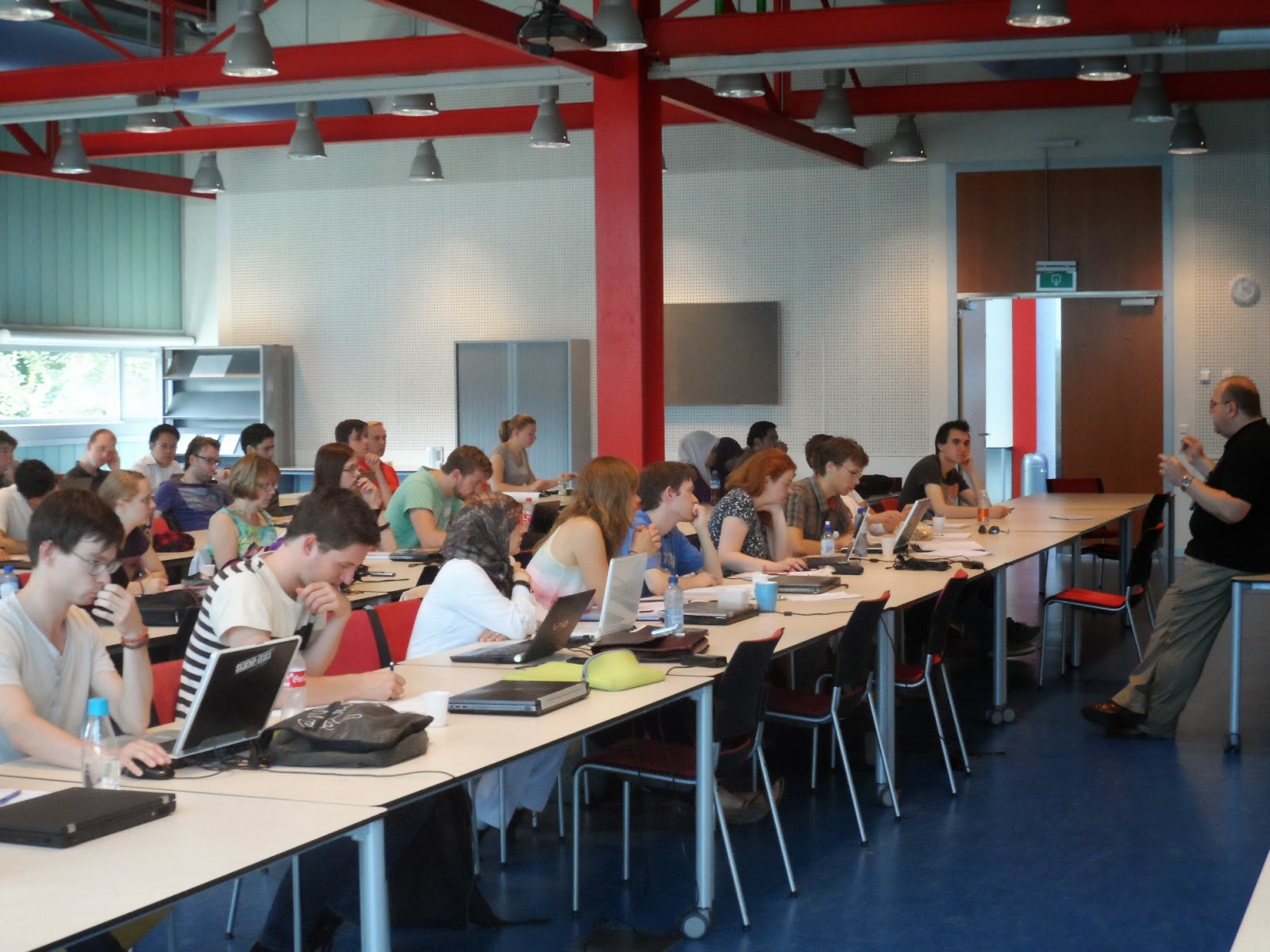
The course "TRIZ Fundamentals 2013" gathered 50 participants this year. It was slightly over the limit but we allowed a greater number of students to register since we expected some last minute cancellations but they did not happen this time.

In addition to 41 B.Sc and M.Sc students we had 9 external guests from industry representing 5 countries.

All the participants were split to 15 groups and each group managed to perform 10 practical assignments. The workload was a bit heavy but at the end of the course everyone looked excited. The following subjects and tools were studied this year:
  • TRIZ background and systematic approach to innovation
  • Ideality and Ideal Final Results
  • Evolution of technology through innovation
  • Root Conflict Analysis
  • 40 Inventive Principles
  • Substance-Field Analysis
  • 76 Inventive Standards
  • Function Analysis
  • Trimming
  • Value Conflict Mapping
  • Introduction to ARIZ
  • Models of Technology Evolution
  • Trends and Lines of Technology Evolution
At the end of the course each participant and student obtained a certificate of TRIZ Practitioner Advanced Level.


Thursday, July 11, 2013

TRIZ Fundamentals 2013 started

On Monday July 8 started another "full immersion" two-week 80-hour training program TRIZ Fundamentals 2013 at Twente University in Enschede. This time there are 51 participants from 6 countries, including a mix of both university students and working professionals. 15 groups will perform 9 assignments during the course.


Wednesday, November 28, 2012

Online Training: TRIZ and Systematic Innovation tools

Since a while I have been running online training in TRIZ and Systematic Innovation. Recently I also added training in specific TRIZ tools for those who would like to study them in more depth than during regular "packaged" training:

http://www.xtriz.com/Training/online_training.htm

Friday, November 09, 2012

Updated: TRIZ and Systematic Innovation courses in 2013


PUBLIC COURSES, 2012:
December 12, 2012
Utrecht, Netherlands
One-day public training and certification:
Systematic Creative Business Problem Solving
PUBLIC COURSES, 2013:
January 9-11, 2013
Utrecht, Netherlands
3-day public training and certification:
Basic TRIZ and Systematic Innovation in Technology and Engineering
February 4-8, 2013
Utrecht, Netherlands
5-day public training and certification:
Advanced TRIZ and Systematic Innovation in Technology and Engineering
April 3-5, 2013
Utrecht, Netherlands
3-day public training and certification:
Extended RIZ and Systematic Innovation in Business and Management
July 2013 (TBD)
Enschede, Netherlands
Two-week (80 hours) Summer Course
TRIZ Fundamentals

Saturday, November 03, 2012

Chapter about TRIZ and Technology Roadmapping in The Power of Design

My chapter about TRIZ and Technology Roadmapping was published in a new book:

The Power of Design: Product Innovation in Sustainable Energy Technologies

Edited by Angele Reinders, Jan Carel Diehl, Han Brezet

368 pages
November 2012
Wiley
ISBN: 978-1-1183-0867-7

Thursday, November 01, 2012

TRIZ Future 2012: Brief Report

Last week I participated at the 12th ETRIA World TRIZ Future Conference in Lisbon, organized jointly by ETRIA, New University of Lisbon, and sponsored by a number of organizations. The conference was chaired by Dr. Cruz Machado and Prof. Helena Navas from the New University of Lisbon, and Dr. Tom Vaneker from ETRIA and the University of Twente.

The event went on October 24-26, 2012. The venue of the conference was at the university campus Caparica, located near the ocean which was really inspiring and provided naturally “fresh” atmosphere.

This time the conference gathered about 90 participants from 27 countries. About 60% of the conference participants represented Europe, 30% Asia Pacific, and 10% other parts of the world, including USA and Australia. The conference featured 4 keynote talks, 2 tutorials, and 60 presentations from 135 authors and co-authors: 28 scientific contributions, 23 practitioner contributions, and 9 short talks. Thanks to the introduction of “short paper” format several years ago, the conference allows short papers to be presented in 10 minutes that extends a number of live presentations at the event. Other papers were presented in a usual, 30 minutes format.

About 50% of the participants represented scientific and research institutions, and about 50% private and industrial organizations.

A full conference program is available. 698-page conference proceedings are available from the organizers. So far it has been the largest volume of the TRIZ Future conference proceedings.

I provided the introductory TRIZ tutorial for the conference participants at the first conference day and later presented a paper on "Functional Value Map" written by my colleagues Ives de Saeger and Kim Rutten.

Social events included the conference dinner, and a dinner with fados, traditional Portuguese style of music and singing. And there was really a lot of informal communication among the conference participants to exchange comments, opinions, ideas, and discussing future collaborations.

The official conference closing was followed by the ETRIA Members meeting where a new President of ETRIA was elected: Prof. Dr. Ir. Joost Duflou, from the K.U. Leuven, Belgium. Many thanks were expressed to Dr. Tom Vaneker, who served as ETRIA President in 2009-2012.

As usual, Ellen Domb, a former editor of the online TRIZ Journal, provided a live coverage of the event with many details, including comments on a number of presentations and keynote talks. See her blog posts about the conference.

The next edition of the conference will be held in Paris, France at the end of October – beginning of November 2013. See the forthcoming news at the ETRIA website.


Friday, September 07, 2012

"TRIZ Future 2012" Preliminary Accepted Presentations

ETRIA Global Conference "TRIZ Future 2012" will be held on October 24-26, 2012 in Lisbon, Portugal.

The list of preliminary accepted presentations:
http://triz.h4u.eu/TFC2012PresentationsPreliminary.pdf
The list of tutorials and keynotes:
http://www.trizportugal.com/keynote-speakers/
I will be running a basic tutorial in the morning during the first conference day.
More information on the conference is available at: http://www.trizportugal.com/

Wednesday, August 08, 2012

Tools Used Most Frequently With 10 Types of Innovative Tasks

In my previous post I introduced 10 types of Innovative Tasks.

According to numerous requests, I made an overview of tools which are used most frequently within xTRIZ framework to support 10 types of innovative tasks. The overview can be found at:

http://www.xtriz.com/cs/10_InnovativeTasks_ToolsTable.pdf

Note that tasks 5,6 and 9 are not currently fully supported by neither xTRIZ nor TRIZ tools. In addition, several tools mentioned were developed within xTRIZ and have no direct link to classical TRIZ tools. Some tools (Problem Perception Map, Multi-Criteria Decision Matrix) are taken from areas other than TRIZ or xTRIZ. In addition, extra tools from different areas can be used in different projects and they are not mentioned in the table.

Friday, August 03, 2012

Ten Types of Innovative Tasks

I am often asked to help with innovation: in products, technologies, or business services. When I talk to people asking me, I find that rather often they do not realize exactly what kind of innovation they want. But innovative solutions and new ideas can vary significantly and solve different types of tasks. On top of that, to use systematic innovation tools (like TRIZ), we need to know what we want to achieve to select a right process.

Therefore I use my own classification of ten categories of tasks which can be identified:
  1. Improve quality of a product, process, or service: e.g. eliminate negative, unwanted and undesired effects, increase robustness.
  2. Improve performance of a product, process, or service: e.g. raise performance of positive effects, functions, or other features.
  3. Increase “compactness” of a product, process or service: e.g. decrease physical dimensions, process or service time, reduce energy consumption, or eliminate human involvement.
  4. Improve ergonomics, usability and use comfort.
  5. Improve design, aesthetics, psychological attractiveness.
  6. Add new functions or features to existing products, process, services.
  7. Create a radically new design (form, shape) of a product.
  8. Radically cut either production or total ownership costs of a product, process, or service.
  9. Find new application areas for an existing product (technology), process or service.
  10. Create a radically new product, technology, process or service.
Some more general tasks like a general innovative improvement of a system, or patent circumvention were not included to this classification since they usually can be decomposed to one of these tasks.

In every area of innovation, a number of solutions in each category grows towards the top of this list. Statistically there are many more innovative solutions improving quality than radically cutting costs, for instance.

The question might arise: are the solutions to the tasks at the bottom of the list address disruptive innovations while solutions to the tasks at the top of the list are incremental? In most cases yes, but not always. Everything depends on a scale of change that should be made to achive a speicifc goal. Sometimes to solve a quality-related problem, for instance, decreasing a number of accidents, a radical change of a basic principle behind a product or a service is needed which results in disruptive innovation.

In addition, according to numerous requests, I made an overview of tools which are used most frequently within xTRIZ framework to support 10 types of innovative tasks. The overview can be found at:

http://www.xtriz.com/cs/10_InnovativeTasks_ToolsTable.pdf

Sunday, July 22, 2012

TRIZ Fundamentals 2012: Summary

Another annual course "TRIZ Fundamentals" is over. It was 2-week course which lasted 80 hours in Enschede, the Netherlands organized jointly by the University of Twente and ICG Training & Consulting.

The total class of 34 persons included B.Sc and M.Sc students from the universities of Enschede and Eindhoven, as well as several experienced guests from the US and Indonesian academy and industry. During each course we allow a limited number of external participants to join the course.

These two weeks provided a really "full immersion" TRIZ experience. Although we started each day at 09:00 and were supposed to finish about 18:00, sometimes students were working till 24:00. And our team of instructors was also busy every night with evaluating student works.

In addition to lectures, each day the participants were split to 11 groups, and each group worked on the following assignments with their own selected problems:
  • Formulation of Contradictions and Ideal Final Result
  • Root-Conflict Analysis (RCA+)
  • Contradiction Matrix and Inventive Principles
  • Function Analysis and Trimming
  • 76 Inventive Standards
  • Value-Conflict Mapping
  • Functional Evolution
  • Evolutionary Potential Analysis and Trends of Technology Evolution.
  • Ideas Evaluation and Landscaping
We also spent a day on solving a problem with ARIZ. The problem was proposed by a student, so it was a bit of a challenge.

Last two days the groups were performing a final assignment which included going through a full xTRIZ process: from problem definition to ideas evaluation and landscaping. This assignment included working on real problems, including problems brought by several participants. Some groups still have to finish their final assignments next week - no problem with that.

Each assignment project was evaluated by me, Tom Vaneker, and Wessel Wits every evening, thus in total we had to check over 100 submitted projects. Most of the time the techniques were used correctly, and many novel and exciting ideas were generated. The marks students got were quite high. As a result everyone obtained a certificate of a TRIZ Practitioner; and B.Sc and M.Sc students obtained 3 European Credits.

But for some students it is not over yet. Those who are interested can continue their formal TRIZ education by doing a TRIZ project at an industrial company or by doing a TRIZ-based research project later this year. These activities will be supported by the University of Twente.

I believe that the course went very well, and I am quite sure knowledge learned and skills gained will remain with most of the participants.

"This course changed the view I see the world", said one of the students during a closing discussion. This is the best evaluation of the course I love to hear.

Some video highlights from the course: http://youtu.be/DQum7BG6DTY (you can also watch it in HD quality).


Saturday, July 14, 2012

TRIZ & Systematic Innovation Public Courses: Fall 2012

The following public courses and certification will be conducted in the Netherlands in Fall 2012:
  • September 5-7, 2012: 3-day TRIZ and Systematic Innovation in Business and Management 
  • September 25, 2012: One-day Creative Imagination Development  
  • October 3-5, 2012: 3-day Basic TRIZ and Systematic Innovation in Technology and Engineering 
  • November 5-9, 2012: 5-day Advanced TRIZ and Systematic Innovation in Technology and Engineering
More details: http://www.xtriz.com/Training/